Our Patient Plan
Date published: 8 May 2026
Summary
By 2030, the East of England Ambulance Service NHS Trust (EEAST) will deliver safe, high-quality urgent and emergency care through empowered people, strong partnerships and modern digital systems that ensure patients get the right care, every time.
In this report
- Introduction
- Our future Patient Care Model
- For our patients
- For our people
- For our regulators and system partners
- Delivering our future Patient Care Model
- Mission delivery on a page
- Delivery timeline
- 1. Integrated navigation and urgent care
- 2. Excellent emergency care
- 3. Neighbourhood and partnership care
- What support activities need to happen to make this work?
- Conclusion
Introduction
An introduction from our Chief Paramedic and Directory of Quality, and Medical Director
In 2025, we published our five-year corporate strategy that sets the direction for how our provision of urgent and emergency care will evolve between now and 2030/2031. The strategy represents more than a commitment to improvement; it outlines a shift in how care is delivered and how responsibility is shared across our urgent and emergency care system. To bring to life the patient and partnership missions within our strategy, we have translated their intent into decisive action.
This strategic plan - our Patient Plan, sets out how our patient care model will be agile to change over time to meet demands of the future, how this will impact patients, our people and partners, and the programmes of work required to deliver this transformation.
It forms one of three strategic plans, sitting alongside our People Plan and our Productivity Plan. These are planned for publication in the spring of 2026. Together, they set out how we will deliver our strategy through meaningful programmes of work that create the conditions for a modern, resilient, and patient-first ambulance service.
Our operating context
Since EEAST was formed in 2006, the service has continued to evolve in response to rising demand, changing patient needs, and increasing pressures across the wider NHS. This trend is structural, predictable, and through population health management will become irreversible unless heath care adjusts.
The deeper challenge, however, is that traditional ambulance operating models are not designed to respond well to this kind of demand. New ways of working are therefore not optional. They are the mechanism through which this strategy will move from working for, to working with, our service users to succeed.
We believe that earlier decisions, fewer handovers, and better information empower clinicians and lead to safer care, fairer access, and better outcomes.
Importantly, this cannot be achieved by the ambulance service acting alone and addressing this challenge requires whole-system partnership change, with shared ownership and interdependencies across urgent and emergency care.
And of course, we operate in an ever-changing environment, meaning we do not yet have the answers to the challenges we will face in future.
Meaningful joint working with our partners is essential to ensuring we design the right solutions for our patients now and in the future.
Simon Chase Chief Paramedic (Allied Health Professional) & Director of Quality

Dr Simon Walsh Medical Director
Our future Patient Care Model
Turning the strategy into visible and measurable change requires clear programmes of work that translate intent into action. We will aim to deliver a coordinated set of programmes, integrated navigation and urgent care, excellent emergency care, and begin building the future shift to better neighbourhood and partnership care, each focused on a core element of our future operating model.
By sequencing improvements across clinical practice, digital modernisation, workforce capability, and system collaboration, these programmes provide the mechanism for safer decisions, faster responses, and better outcomes and not just traditionally meeting an increased need.
The future patient care model describes the outcomes we must deliver by 2030 onwards and the capabilities required to achieve them. It sets a clear scope for what will change, how it will change, and what the end state will look and feel like for patients, our people, and our partners.
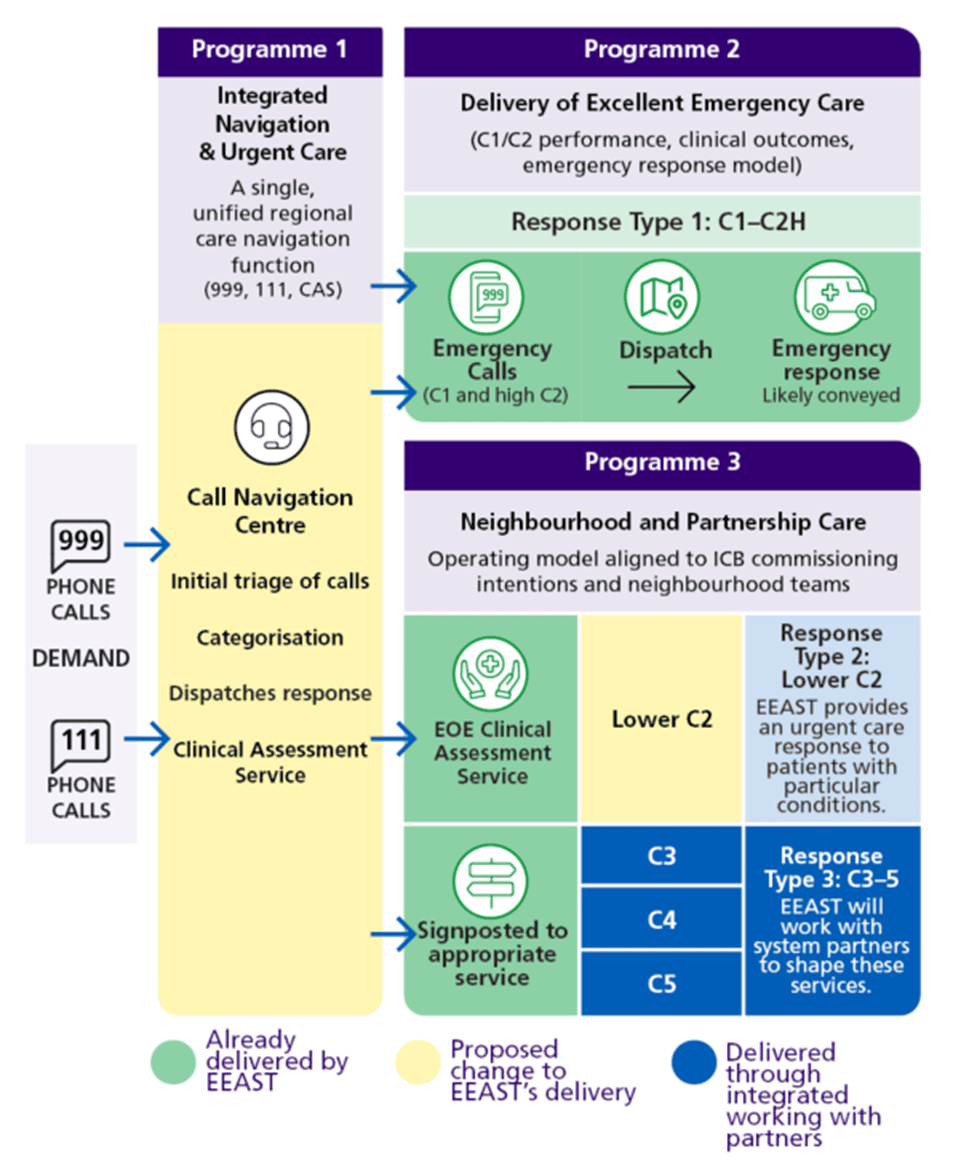
Summary of graphic above
The model outlines how patient demand from 999 and 111 calls is managed through three linked programmes.
Programme 1 provides a single navigation and triage function via the Call Navigation Centre and Clinical Assessment Service, which categorises patients and directs them appropriately.
Programme 2 focuses on delivering excellent emergency care for the most urgent cases (C1 and high C2), ensuring rapid dispatch and response, often involving hospital conveyance.
Programme 3 manages lower-acuity patients through neighbourhood and partnership-based care, using clinical assessment, urgent care responses, and signposting to appropriate services, with increasing collaboration across the wider health system.
For our patients
By 2030, accessing care from the ambulance service will feel more consistent, integrated and more predictable. Whether contacting 999, 111 or using the NHS App, the public will experience a service that listens, understands what they need, and takes responsibility for navigating the right outcome with view to work with the patient.
What patients will experience by 2030
- The first point of contact - whether through 999, 111, or digital access - will provide clarity and reassurance, reducing anxiety for patients during moments of uncertainty.
- Call handlers, supported by advanced clinical tools and access to senior clinicians, will answer calls promptly and assess what the patient genuinely needs including life-saving advice. In life-threatening situations, our system (Advanced Medical Priority Dispatch System known as AMPDS) rapidly identifies these calls and dispatches the appropriate response to optimise the outcome for the patient.
- Patients whose conditions can be safely managed in the community will be navigated to urgent treatment centres, primary care, mental health services, community support, or provided with self-care advice, supported by planned follow-up with a focus on working with the patient.
- Patients will experience fewer handovers between services and will not need to repeat their story multiple times.
- The service will feel safe, coordinated and accountable, with decisions made once using the best available information on system capacity, clinical pathways, and patient history.
Outcomes to be achieved
- Patients consistently receive the right care, every time, regardless of entry point.
- Decision-making is faster, safer, and better supported by clinical expertise and technology that is understood by the patient.
- Conveyance to hospital reduces, where it is safe and appropriate. And over time, the proportion of our responses to patients where they are conveyed to hospital increases, as we only send an ambulance when it is needed.
- Patients experience clearer, calmer, and more reliable navigation through urgent and emergency care and feel ‘worked with’ and ‘not for’ as confidence develops with the future shift to neighbourhood care.
For our people
Supporting our workforce is fundamental to safe and effective care. By 2030, our people across EEAST, frontline clinicians, Emergency Operation Centre (EOC) teams, Non-Emergency Patient Transport Services (NEPTS), corporate colleagues, managers, and volunteers will experience greater clarity, stronger support, and better tools to perform their roles with confidence.
What our people will experience by 2030
- Frontline clinicians will have better access to real-time information and relevant specialist support enabling them to arrive prepared, reducing avoidable delays and enable reflection through population health management data that will also provide intelligence to how the health care partnership systems need to adapt to changing needs of the patient.
- A broader mix of clinical and non-clinical roles will be in place, reflecting the needs of modern urgent and emergency care such as establishing advanced and enhanced practice in the right part of the health care system.
- Our people will work in effective teams, allowing meaningful and more regular interaction with their line managers.
- Our EOC teams will have greater senior clinical support which will better support patient navigation.
- Our volunteers will be a core component of how we provide care for our communities and support our people.
- Corporate and support services will work in closer alignment with operational needs, eliminating competing processes and creating a single organisational direction.
- Managers will have clearer responsibility for the people they support, enabled by streamlined corporate services and consistent policies across the organisation.
Outcomes to be achieved
- Through clinical supervision and feedback though accessing clinical data such as via the Federated Data Platform (FDP), our people feel equipped, supported, and confident in their decision-making.
- Workforce capability aligns to the needs and demands of modern urgent and emergency care, including advanced and enhanced practice, community roles, volunteers and call-handling specialisms.
- Sickness, turnover, and burnout reduce due to improved mental health support, leadership capability, and clarity of purpose.
- Training and education completion rates improve as access to learning becomes more targeted, structured, and relevant to evolving roles.
For our regulators and system partners
By 2030, EEAST will demonstrate clarity of purpose, responsible use of resources, and consistent, reliable performance across urgent and emergency care.
What partners will experience by 2030
- Our regulators will see year-on-year improvement in Category 1 and Category 2 response times, underpinned by strong clinical governance and data-driven assurance.
- Integrated Care Boards/Partnerships (ICBs and ICPs) will experience a more aligned and proactive partner, contributing to health data, improved system flow, more appropriate conveyance, and reduced avoidable admissions.
- Community, mental health, and primary care partners will have clearer referral pathways and earlier involvement in patient care.
- The system will benefit from improved navigation across UEC services, reducing duplication and variation with the aim of working with patients.
Outcomes to be achieved
- The Category 1 and Category 2 national standards of seven and 18 minutes respectively becomes a reliable and sustainable reality.
- System-wide patient flow improves as conveyance becomes more appropriate and handover delays reduce as only those that need to go to hospital are taken.
- The service demonstrates clarity, reliability, and a commitment to patient safety through reduced harm being seen and through more compliments being given with improvements year on year achieved.
- We are recognised by partners and commissioners as the region’s urgent and emergency care navigator, not solely an emergency transport provider and learns how EEAST can support the future shift to neighbourhood care.
Delivering our future Patient Care Model
To turn the strategy into measurable change, we will deliver a coordinated set of programmes that translate strategic intent into practical, system-level improvement. Each programme begins with a focus on a core element of our future operating model: integrated navigation and urgent care; emergency care excellence; and the future shift to neighbourhood and partnership care. Together, they provide the mechanism for safer decisions, faster responses, and better patient outcomes.
These programmes bring structure to the transformation ahead, outlining the specific changes, capabilities, and partnerships required to realise our strategic ambition. By sequencing improvements across clinical practice, digital modernisation, workforce capability, and system collaboration, the programmes of work ensure that the strategy moves from vision to reality, creating a service designed to meet the needs of patients now and into 2030.
Mission delivery on a page

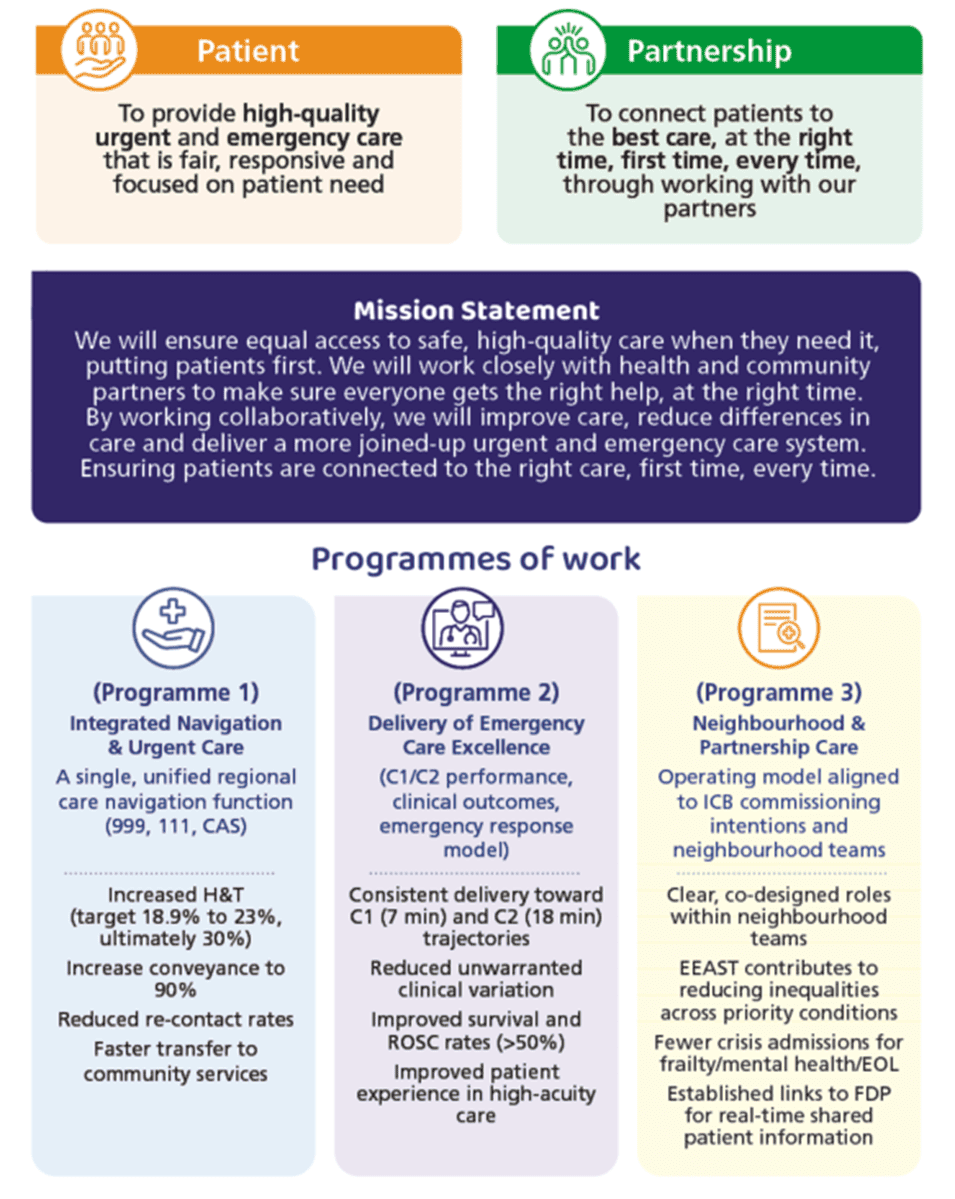
Summary of image above
A structured infographic presenting a healthcare strategy organised into sections.
At the top are two coloured panels: an orange “Patient” panel stating the aim to provide high-quality urgent and emergency care that is fair, responsive, and patient-focused, and a green “Partnership” panel describing the goal of connecting patients to the best care at the right time through collaboration with partners.
Below, a large purple “Mission Statement” box explains the commitment to equal access, safe and high-quality care, partnership working, reduced inequalities, and a more integrated urgent and emergency care system.
The lower section is titled “Programmes of work” and contains three columns. Programme 1, in light blue, covers integrated navigation and urgent care, highlighting a unified system across 999, 111, and clinical assessment, with improvements in triage, hear-and-treat rates, reduced recontacts, and faster access to community services. Programme 2, in purple, focuses on emergency care excellence, including meeting response time standards for high-priority calls, reducing variation, improving survival rates, and patient experience. Programme 3, in pale yellow, describes neighbourhood and partnership care, including alignment with local commissioning priorities, reducing inequalities, fewer crisis admissions, clear team roles, and improved information sharing with partners.
Icons accompany each section, and the layout flows from overall vision and mission at the top to detailed programme delivery at the bottom.
Delivery timeline
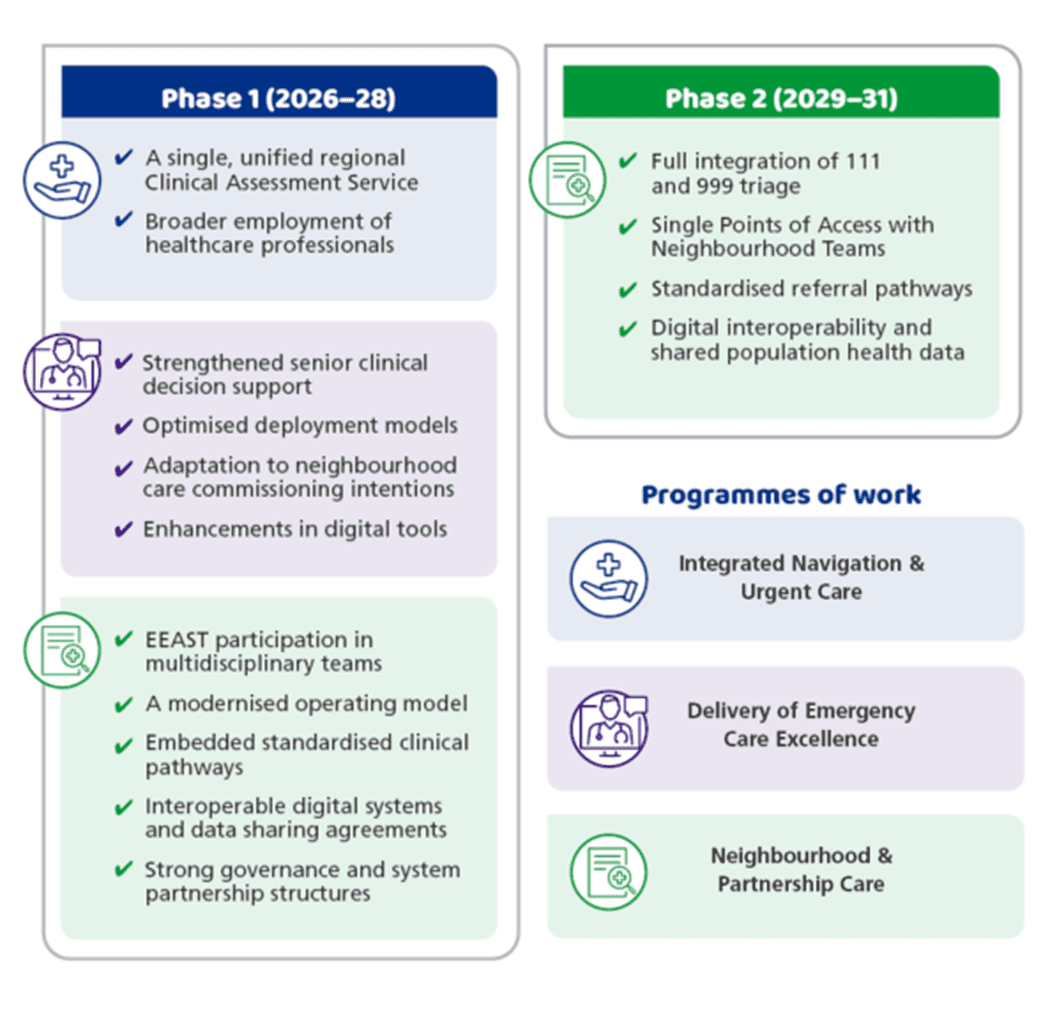
Summary of image above
A two-phase strategic infographic showing the development of urgent and emergency care services.
On the left, a blue panel titled “Phase 1 (2026–28)” contains three grouped sections with bullet points. These include establishing a single regional Clinical Assessment Service, expanding the healthcare workforce, strengthening clinical decision support, improving deployment models, aligning with neighbourhood commissioning, enhancing digital tools, and increasing partnership working through multidisciplinary teams. Additional points include modernising the operating model, embedding standardised clinical pathways, improving digital interoperability and data sharing, and strengthening governance and partnerships.
On the right, a green panel titled “Phase 2 (2029–31)” lists key goals: full integration of 111 and 999 triage, creation of single points of access linked to neighbourhood teams, standardised referral pathways, and shared digital systems with population health data.
Below, a section titled “Programmes of work” presents three labelled boxes with icons: Integrated Navigation and Urgent Care, Delivery of Emergency Care Excellence, and Neighbourhood and Partnership Care.
The layout clearly shows progression from Phase 1 foundations to Phase 2 integration, supported by the three programmes.

1. Integrated navigation and urgent care
The way patients are navigated through urgent and emergency care is central to their safety, experience, and outcomes. By 2030, we will strive to operate as a single, unified regional care navigation function, bringing together 999, 111, and our Clinical Assessment Service (CAS) into one coordinated model.
This programme focuses on creating that integrated system, ensuring that every caller receives consistent, clinically informed decision-making at the earliest possible point. By aligning triage processes, reducing duplication, standardising referral pathways, and leveraging shared digital infrastructure, this programme will enable more patients to be safely treated without conveyance, increase Hear and Treat rates, use virtual See and Treat and ensure that callers move seamlessly to the right service with the patient being at the centre of the decision making. It provides the foundation for a more efficient, joined-up, and patient-centred urgent care system across the entire region the shows we aim to work with patients and move away from working for them.
Focused changes to deliver
- Creation of a single, unified regional CAS, delivered in collaboration with partner providers to improve patient care.
- Through a detailed review of our response to patients, we will develop an intelligent model of response, which will allow us to better use our resources to ensure patients receive the right kind of response for their presenting conditions.
- Integration of advanced clinical support systems into the early stages of triage, ensuring that decisions are clinically informed and risks are managed effectively for the patient’s presenting condition.
- Implementation of digital platforms that provide real-time information about available services, hospital capacity, local pathways, and patient records.
- Integration with 111 services to support more effective and coordinated navigation of calls. EEAST’s ambition over time is to work with partners to deliver 111 services, which could include EEAST directly delivering these services or through an alliance contracting approach, binding the relationship to specific outcomes to achieve this ambition.
- Establishing shared referral pathways across all ICBs, ensuring patients are directed quickly and consistently to the right service with improved interoperability
- Embedding technology that enables decisions to be made once, supported by automated routing and reliable access to patient information, and allows for digital interoperability.
Measures of success
- Our Hear and Treat rates will increase to at least 30% over the period through better use of our clinicians and partners supporting greater opportunities to access care.
- Through more accurate clinical decision-making over the phone, through use of advanced paramedics (urgent care) and with on-scene times reducing year-on-year to at least five minutes.
- The conveyance rate for where we determine a patient needs to go to hospital increases to high levels as only those that really need an ambulance are conveyed to hospital.
- Re-contact rates within 24 hours to fall year-on-year as patients receive the right care and follow-up at the first point of interaction.
- Transfers to community services become faster and more reliable, supported by aligned commissioning and improved referral infrastructure.
2. Excellent emergency care
Delivering consistently high performance in Category 1 and Category 2 (immediate dispatch) responses is foundational to the safety, credibility, and effectiveness of EEAST. This programme focuses on strengthening the core emergency response model, improving the quality and reliability of clinical outcomes, and ensuring that patients experiencing life-threatening or serious conditions receive the fastest and most appropriate care from the highest skilled partitioners required to meet the patient need.
By bringing together enhanced and advanced trained clinicians, modern deployment models, better digital tools, and clearer alignment with commissioning intentions, this programme will create the conditions for sustained improvement in emergency performance. It will enable faster response times, reduce unwarranted clinical variation in care provided by established and accepted clinical supervision and Crew Resource Management, and ensure that every high-acuity patient receives safe, timely, and evidence-based care every time, across every part of the region by the most appropriate clinicians.
Focused changes to deliver
- Strengthening senior clinical decision support within control rooms and operationally through an expanded Crew Resource Management model and Advanced Practice roles.
- Optimised deployment models, including the utilisation of volunteer first responders, rapid response vehicles, advanced practitioners and HEMS through clear dispatch rules.
- Enhancements in digital tools that provide real-time data, intelligent dispatching, and advanced communication capabilities with future artificial intelligence support for clinical note taking.
- Adaptation to commissioning intentions related to neighbourhood care, end-of-life, frailty, cardiac and respiratory pathways, and other shared pathways with acute hospitals as they come online.
Measures of success
- Consistent year-on-year improvement toward achieving Category 1 (seven minutes) and Category 2 (18 minutes) response standards.
- Reduced unwarranted clinical variation across all areas. This will be driven by greater clinical supervision and by reducing variation identified through case review and audit. As a result, patients will receive consistent decisions and care across the Trust, no matter where their episode of care occurs.
- In cardiac arrest patients we will improve the rate of Return of Spontaneous Circulation (ROSC), to consistently exceeding 30% with improved survival to discharge above the national mean.
- To support this target, we will grow the number of people that are trained to undertake cardiopulmonary resuscitation (CPR) and improve how we support the scene of these incidents through ensuring we have senior clinicians who can support and guide people to undertake CPR.
- Improved patient experience for those requiring high-acuity emergency care through reduced patient incidents and greater number of compliments seeing this improving year on year.
3. Neighbourhood and partnership care
As patient needs become increasingly complex, we are best placed to build on a stronger and more proactive role within neighbourhood and community-based models of care. This programme focuses on aligning our operating model with Integrated Care Board (ICB) commissioning intentions and ensuring EEAST becomes a fully integrated partner within neighbourhood-level multidisciplinary teams.
The emphasis is on reducing avoidable crises, improving local coordination, and enabling patients with frailty, long-term conditions, mental health needs or end-of-life requirements to receive timely support closer to home. Achieving this requires new shared pathways, better use of data, and joint workforce approaches with community services, primary care, mental health teams and the voluntary sector with the aim to work with patients.
By strengthening these partnerships and aligning our clinical capability with neighbourhood operating models, EEAST will help reduce inequalities, improve patient outcomes, and contribute to a system that prevents rather than reacts to avoidable episodes of deterioration. This future shift will also ensure we remain equipped to respond effectively to emergencies while supporting broader improvements in population health.
Our partnership approach
Delivering this mission requires a deliberate and structured approach to system collaboration.
We will establish clear engagement routes at regional, ICB, place and neighbourhood level, ensuring that pathway design, demand management, workforce planning and digital integration are jointly developed with patients. Our clinicians and leaders will participate in multidisciplinary neighbourhood teams and system governance forums, supported by shared data, transparent decision-making and aligned commissioning intentions. This approach ensures that improvements are co-designed, risks are managed collectively, and outcomes are delivered through genuine system partnership that the patient understands and accepts.
Focused changes to deliver
- Developing a modern approach to resource deployment, clinical decision support, and digital capability that moves beyond the traditional ambulance service model.
- Through our community responses, advanced clinicians can intervene early, using their enhanced skills to manage and slow patient deterioration. By working in closer partnership with community providers, multidisciplinary teams can offer timely, coordinated support should a patient’s condition worsen, ensuring a seamless continuum of care.
- Embedding clear, standardised clinical pathways across all ICBs to reduce clinical variation across the region for our patients.
- Establishing interoperable digital systems that share real-time information between EEAST, hospitals, community teams and other appropriate partners. This includes shared data agreements that enable appropriate access to tools such as the Federated Data Platform.
- Stronger governance and system partnership structures that support collective decision-making and shared accountability. Measures of success
- Clinically and non-clinically defined roles for EEAST will be clearly articulated and co-designed within neighbourhood teams, ensuring the ambulance service is fully embedded as a core partner.
- EEAST will play a direct role in tackling health inequalities across ICB-identified priority conditions, contributing to measurable improvements in regional health index outcomes.
- Unplanned and crisis-driven admissions for people living with frailty, mental health needs, and those requiring end-of-life care will decrease, supported by earlier intervention and more consistent community-based support.
- Teams will benefit from real-time access to shared patient information through shared data platform capability such as the Federated Data Platform, enabling faster, safer, and better-informed clinical decision-making.
- Greater system integration will enable EEAST to develop more mature and effective admission-avoidance models, supporting its strategic ambition to become a fully integrated healthcare provider working in partnership with patients.
- By supporting the shift from acute hospital reliance to proactive community prevention, EEAST will help deliver more personalised, community-based care. This will be achieved by integrating its workforce with neighbourhood teams, utilizing established community pathways, and advancing towards a unified digital platform that strengthens local care management.
What support activities need to happen to make this work?
Our People Plan – Building the workforce and the environment to deliver the future patient care model
Delivering the 2030 Patient Care Model depends on a workforce with the capability, confidence, agility and support to make safe and effective decisions every day. The People Plan sets out how we will develop the right mix of roles, strengthen clinical capability, and create an environment where our people can thrive. It will focus on expanding advanced and enhanced practice, developing integrated training across 111, 999, EOC and CAS, and building clear career pathways for clinicians and non-clinicians.
Leadership capability, well-being support, and consistent people management will be strengthened so that our people feel supported and equipped in their roles. By aligning recruitment, education, and workforce development with the future operating model, the People Plan will ensure we have the skills and culture required to deliver the strategy’s ambition: the right care, every time, by empowered and well-supported teams.
What we will deliver
- Implementation of the Advanced and Enhanced Practice roadmap, supported by national and regional evidence that place senior clinicians where they create the most value, supported by commissioning intentions.
- Expansion of the Education Academy and development of an integrated training model across 111, 999, EOC, and CAS.
- Establishment of clear paramedic and non-paramedic career pipelines, supported through partnerships with Higher Education Institutions.
- Introduction of a Critical Risk Management (CRM) platform, enabling better clinical oversight and support at the frontline.
- Alignment of recruitment activity with commissioning requirements, ensuring the right skills and roles enter the workforce at the right time.
Outcomes to achieve
- EEAST develops a workforce with the right mix of skills to support navigation, urgent care, and emergency response. This provides a clinical career structure for our people allowing them to grow and stay with EEAST.
- Employee experience improves through better support, clearer expectations, and more consistent leadership.
- Retention improves as our people feel valued, supported, while being able to thrive and develop.
- Mental health support becomes more proactive, reducing sickness levels.
- Training becomes more consistent and aligned with future roles, improving education completion rates.
Productivity Plan – Modernising our organisation and delivering value for money
To deliver the 2030 Patient Care Model, EEAST must modernise the systems, processes, and ways of working that shape every stage of the patient’s journey. The combined organizational and digital modernization agenda sets out how the organization will build the technological and operational foundations needed for faster decisions, more reliable care pathways, and a consistently high-quality patient experience. Central to this is our commitment to sustainability for the benefit of our patients, people and communities. This work focuses on equipping our people with modern digital tools, optimized assets and more efficient processes, strengthening clinical decision support, reducing administrative burden, and ensuring real-time data is available wherever care is delivered.
What we will deliver
- A digital roadmap that delivers critical digital innovation over time, including optimizing our Electronic Patient Clinical Records (ePCR) system, and adoption of future technologies like Artificial Intelligence (AI) and a platform that supports population health management and clinical education and supervision.
- A sustainable estate and fleet plan that optimizes how we use our physical assets to improve our response to patients and deliver on our sustainability agenda.
- Comprehensive review of our policies and processes, embedding digital innovation to reduce administrative burden and time spent, and ensuring consistent application.
- A culture of co-ownership between operational and clinical teams, embedding continuous improvement into daily practice.
- Routine use of data to drive improvement, identifying unwarranted variation and enabling targeted action.
Outcomes
- Digital tools enable improved response times, faster decision-making, and better prioritisation of resources.
- Real-time data is reliably available at every patient touchpoint, enabling one version of the truth across the care pathway.
- Our people spend less time on administrative tasks, enabling more time for clinical care and reducing unnecessary workload.
- EEAST delivers improved value for money through efficient, consistent, and reliable care.
Conclusion
This Patient Plan sets out how we will transform the way urgent and emergency care is delivered across the east of England, through clearer navigation, stronger emergency care, and deeper integration within the future shift to clearer neighbourhood teams.
Delivering this change requires more than internal reform; it depends on genuine system partnership, shared accountability, and coordinated action across ICBs, ICPs, providers, and communities.
By modernizing our workforce, our digital and data tools, and our operating model, we will create conditions for safer decisions, faster responses, and more consistent patient outcomes.
Together with our partners, we will build a modern ambulance service that is proactive, connected, and capable, ensuring that by 2030 every patient receives the right care, every time moving from working for to working with the patient for the best outcomes.