
Green Plan 2021-26 Addendum
Date published: 4 February 2026
Summary
Report Period: 07/2025-12/2026 Date of Report: 31/10/2025
In this report
- Document Change History
- 1. Introduction
- 2. Review of Green Plan 2021-26
- 3. Areas of Focus
- 3.1 Workforce and System Leadership
- 3.2 Travel and Transport
- 3.3 Adaptation
- 3.4 Estates and Facilities
- 3.5 Green Spaces, Health and Wellbeing
- 3.6 Supply Chain and Procurement
- 3.7 Medicines
- 3.8 Food and Nutrition
- 3.9 Digital Transformation
- 3.10 Net Zero Clinical Transformation
- 4. Green Plan Governance
- 5. EEAST Strategy 2025-2030
- 6. Tracking and Reporting Progress
Document Change History
| Initiated by | Date | Author(s) |
|---|---|---|
| NHS England requirement | 5 February 2025 | Environment and Sustainability Manager |
| Version | Date | Comments |
| 0.1 | 7 July 2025 | Addendum reviewed by Sustainability Working Group. |
| 0.2 | 11 July 2025 | Reviewed following input from Regional Net Zero Programme Lead, NHSE and Sustainability Lead, Suffolk and North East Essex ICB. |
| 0.2 | 21 July 2025 | Sent to Finance and Sustainability Committee for approval at 30 July 2025 meeting. |
| 0.3 | 20 August 2025 | Reviewed following input from Head of Procurement and Logistics and Finance and Sustainability Committee. |
| 0.3 | 22 August 2025 | Sent to Executive Leadership Team for approval at 26 August 2025 meeting. |
| 0.4 | 17 October 2025 | Reviewed following input from CEO, CFO and Head of Estates on 25 September 2025 and with input from Regional Net Zero Programme Lead, NHSE. |
| 0.5 | 31 October 2025 | Reviewed following input from Executive Leadership Team meeting on 28 October 2025. |
| 1.0 | 5 November 2025 | Approved by Public Board on 5 November 2025. |
1. Introduction
This addendum to the East of England Ambulance Service NHS Trust’s (EEAST) Green Plan 2021-26 (Green Plan 2021-2026) is to fulfil the requirements of the NHS England Green Plan Guidance published on 4 February 2025. This addendum sits alongside our Green Plan 2021-2026 and has been written to ensure we are compliant with current Green Plan Guidance until the next EEAST Green Plan is published. This document sets out our progress against the 2025 Guidance and key actions and recommendations for our next Green Plan. We plan to refresh the Green Plan in 2026 through a full consultation process.
A full review of the EEAST Green Plan 2021-26 is published as a Progress Report in a separate document.
In line with other NHS organisations and our legal commitment outlined in the Health and Care Act 2022, the Trust is committed to reaching net zero greenhouse gas emissions for those emissions we can control by 2040 and for those emissions we can influence by 2045. We have set an organisational target to reduce absolute emissions we can control by 50% by 2030 (using a 2019/20 baseline).
2. Review of Green Plan 2021-26
The Environment and Sustainability Manager and Sustainability Engagement Coordinator have made a self-assessment of the Trust Green Plan 2021-26. This included looking at progress made on the aims for each of the ten Areas of focus as well as considering maturity compared with the previous Green Plan Guidance published in June 2021. Every aim within each area of focus was then given a RAG rating according to the following method:
| RAG Key | Progress | Risk of not achieving within period of Green Plan 2021-26 |
|---|---|---|
| GREEN | Achieved or ongoing practise | Low |
| AMBER | In progress | Medium |
| RED | Not achieved | High |
The following is a summary of the self-assessment from 18 July 2025. Another self-assessment will be made as part of the consultation process for our next Green Plan.
| Area of focus | Assessment of progress made | Maturity compared with Green Plan Guidance | RAG rating |
|---|---|---|---|
| Workforce and System Leadership | Good progress with engagement with certain groups, but limited action on training the entire workforce. Governance processes have improved with a clearer reporting process to Board. Growth of sustainability team has greatly increased capacity for staff communications and engagement. | Good investment in specific staff to support sustainability goals but not included in Green Plan actions (sustainability team and apprentices). Green Plan does not monitor the effectiveness of engagement or governance. | AMBER |
| Travel and Transport | Some progress made in reducing the impact of fleet, but further work needed considering the importance of this emissions source. Limited investment in low/ultra-low and zero emission vehicles due to infrastructure delays. Travel plans are needed to reduce the impact of business travel and commuting. | Does not consider patient transport, courier services or deliveries. | RED |
| Adaptation | No Adaptation Lead or Climate Change Adaptation Plan, apart from EPRR activity. | Winter Plan needs to consider changing climate and impact on infrastructure, patients, and staff. A Summer Plan needs to be developed. There is a new recommendation to use adaptation framework and an expectation to do a Climate Change Risk Assessment for sites. | RED |
| Estates and Facilities | Significant progress made in capital projects with dedicated budget line for sustainability, with growing resource. External technical expertise and buy-in from across the Trust for data collation is needed for full carbon footprinting. Growth of sustainability team has greatly increased capacity for energy auditing and analysis. BREEAM Excellent specified for new builds | Comprehensive cover for this area of focus due to Sustainability being based within Estates department. | GREEN |
| Biodiversity, Health and Wellbeing | Good progress on individual biodiversity health and wellbeing initiatives, particularly wellbeing gardens, tree planting and GoodDogs scheme. No progress on Trust-wide Green Space and Biodiversity Development Plan. | This area of focus is in addition to the Green Plan Guidance. | AMBER |
| Supply Chain and Procurement | Good progress on aims added to Green Plan, with initiatives from individual departments, e.g. Stores. Trust-developed mandatory waste training is particularly innovative | Some unrealistic targets in Trust Green Plan, which does not follow the Guidance. Some of the Trust aims are from the Estates and Facilities area of focus, rather than related to supply chain and procurement. | AMBER |
| Medicines | Good progress made in monitoring Entonox and have seen a consistent reduction. Entonox data comes from the supplier, so unknown if reduction is due to cylinder loss (e.g. at hospitals) or theft. | We have not been active in this area – focussing on Entonox only. | RED |
| Food and Nutrition | Trust does not have a food service, but food is offered to staff via vending machines and Welfare Wagons. There has been limited activity to make this healthier, apart from zero sugar soft drinks. | No actions to reduce food waste, disposal activities only provided due to legislation changes. Limited or no activities to improve nutrition. | RED |
| Digital Transformation | Some progress made utilising data and digitalisation of paper-based operations from individual departments. Sustainability dashboard was in draft, but unable to take forward due to loss of technical resource. No progress on monitoring purchasing reports for impact of sustainability initiatives | No Trust aims related to harnessing digital technology for clinical transformation. | RED |
| Sustainable Care Models | No clinical lead and limited communication on health benefits of sustainability. | No Trust aims related to clinical transformation, despite some progress in this area e.g. expansion of cycle response unit, Hear and Treat. | RED |
| Assurance | Steven Course (Finance Director has been appointed as the senior responsible officer for our Green Plan. | We need a lead for adaptation. Progress of the delivery of our Green Plan is published in the Trusts annual report. The current guidance suggests that we develop a sustainability impact assessment. | RED |
Conclusion
The EEAST Green Plan 2021-26, was produced by the Sustainability Team at the time with consultancy from the Carbon Trust. There was no full consultation process or co-production with divisions/departments throughout the Trust. The Green Plan contained many aims for each Area of focus without an agreed action plan with senior responsible officers and SMART targets, consequently it has been challenging to make significant progress in some areas. A strength of the Trust Green Plan was to include an additional area of focus (Biodiversity, Health and Wellbeing) which was recognised as leading within our region. Some actions need to be revisited due to insufficient progress and there are some new key actions and recommendations from the Green Plan guidance which the board needs to consider along with who will be responsible for these and when they are due.
3. Areas of Focus
The Trust has 10 key areas of focus for our Green Plan. The following sub-sections show our progress to date following the 2025 Green Plan Guidance. Key actions (mandatory) or recommendations for best practice which will form the basis for our next Green Plan are listed, including suggested target dates and roles and responsibilities. A full consultation process is needed for our next Green Plan to align with Trust strategy, therefore target dates and roles and responsibilities may be revised.
3.1 Workforce and System Leadership
| 2025 Green Plan Guidance Key Actions | Progress to date: (note: SMART targets and roles and responsibilities need to be formalised as part of Green Plan Consultation). |
|---|---|
| Appoint a designated board-level net zero lead, generally an existing executive director, to oversee green plan delivery with clearly identified operational support. | We have a Net Zero Board Lead (a non-executive director) and have appointed an executive director to chair our Sustainability Working Group. We also have a Social Value Lead to oversee our Social Value Plan (a non-executive director). |
| Assess workforce capacity and skill requirements for delivering the green plan, considering good practice examples such as hybrid roles, apprenticeships, fellowships and NHS estates sustainability career pathways. | The Trust is leading the sector with two clinical engineering staff in the first cohort of a new 15-month sustainability apprenticeship (Sustainable Healthcare Academy) via LDN Apprenticeships (started September 2024). We are advertised for the October 2025 cohort and have an emergency operations administrator on the cohort. These roles help train staff in different areas of the Trust in sustainability which is important for staff to meet their statutory duty via the Health and Care Act 2022. Within the apprenticeship, the students undertake various projects across their area which helps drive sustainable change and therefore, reduce emissions. The Social Value and Sustainability Contract Management Lead post is vacant due to budgetary constraints. |
| Promote specialist training for staff groups who underpin the delivery of green plans, such as board members, procurement, finance, estates and facilities staff and clinicians. | The Centre for Sustainable Healthcare provided Net Zero Leadership Training for the Trust Board and senior leaders on 2 April 2025. The Net Zero Board Lead and other non-executive leaders completed Net Zero Board Level Training, provided by Centre for Sustainable Healthcare in June and November 2023. The procurement department have completed Social Value training provided by Government Commercial College. Estates Category Manager attended Sustainable Procurement training provide by Centre for Sustainable Healthcare in May 2023. Since 26 September 2024 sustainability is included in all staff inductions. Give training to staff to ensure they can meet their statutory duty via the Health and Care Act 2022. |
| Sharing best practice across partner organisations, supporting collaboration and facilitating engagement with relevant research and innovation activities, such as through health innovation networks. | We have significant experience of sharing best practice across organisations, such as the clinical waste to hospitals project which we shared with NHS England and other ambulance services. The Measuring Air Pollution from ambulances research project entails collaboration between EEAST, Addenbrookes Hospital, Anglia Ruskin University, University of Suffolk and EMSOL. We are now investigating, with the help of Greener NHS East of England, how to improve our linen contract and processes across the region to ensure that linen remains sustainable, increasing reuse, reducing waste, reducing costs and improving system efficiency. |
| Key Actions and Recommendations from the 2025 Green Plan Guidance | Mandatory or Best Practice | Job Role/Department Responsible | Due Date |
|---|---|---|---|
| Appoint a designated board-level net zero lead, generally an existing executive director, to oversee green plan delivery with clearly identified operational support. | Mandatory | Executive Leadership Team | October 2025 |
| Work at ‘Place’ to facilitate/participate in collaborative sustainability efforts and support partnership working within the local community. | Mandatory | Environment and Sustainability Manager, Head of Estates, Research Team, Executive Leadership Team | December 2028 |
| Assess workforce capacity and skill requirements for delivering the green plan, considering good practice examples such as hybrid roles, apprenticeships, fellowships, and NHS estates sustainability career pathways | Mandatory | People Services, Head of Operations | December 2028 |
| Sharing best practice across partner organisations, supporting collaboration, and facilitating engagement with relevant research and innovation activities, such as through health innovation networks | Mandatory | Environment and Sustainability Manager, Head of Estates, Research Team, Executive Leadership Team | December 2028 |
| Promote, and consider setting uptake targets for, core training offers set out on the Greener NHS Training Hub | Mandatory | Environment and Sustainability Manager, Executive Leadership Team | December 2028 |
| Promote specialist training for staff groups who underpin the delivery of green plans, such as board members, procurement, finance, estates and facilities staff and clinicians | Mandatory | Learning & Development, People Services, Environment and Sustainability Manager | December 2028 |
| Recognise the organisations' legal commitment towards achieving net-zero emissions (in line with the Health and Care Act 2022) e.g. in the published values, mission statement and principles of health organisations. | Best Practice | Legal Team, Head of Finance, CEO, Executive Leadership Team | December 2028 |
| Establish and promote 'green' staff benefits, including cycle-to-work schemes and access to electric vehicles and promote home energy improvements and low carbon goods/services. | Best Practice | Sustainability Engagement Co-Ordinator | December 2028 |
| Engagement with research and innovation activities to support the transition to a net zero NHS. | Best Practice | Head of Research, Transformation Team | December 2028 |
3.2 Travel and Transport
| 2025 Green Plan Guidance Key Actions | Progress to date. (note: SMART targets and roles and responsibilities need to be formalised as part of Green Plan Consultation). |
|---|---|
| Support zero-emission ambulance pilots, followed by evaluation and at-scale transformation in readiness for the procurement of zero-emission ambulances from 2030. | As part of the NHS England pilot, we have 3 Ford E-Transit DSAs due for delivery in August 2025 and to be operational from October 2025. A further 5 Ford E-Transit DSAs are due for delivery in February-March 2026. |
| Key Actions and Recommendations from the 2025 Green Plan Guidance | Mandatory or Best Practice | Job Role/Department Responsible | Due Date |
|---|---|---|---|
| Develop a sustainable travel plan by December 2026, to be incorporated into our next Green Plan, focusing on active travel, public transport and zero-emission vehicles, supported by a clear understanding of staff commuting. | Mandatory | Environment and Sustainability Manager, Sustainability Engagement Coordinator, Procurement, Fleet Service, Operations, Patient Transport Service | December 2026 |
| Offer only zero-emission vehicles through vehicle salary sacrifice schemes from December 2026 onwards (for new lease agreements). | Mandatory | Procurement, Fleet Service, Operations, People Services, Patient Transport Service | December 2026 |
| Make arrangements to purchase, or enter into new lease arrangements for, zero-emission vehicles only from December 2027 onwards (excluding ambulances). | Mandatory | Procurement, Fleet Service, Operations, Patient Transport Service | December 2027 |
| Section 18 of the NHS Standard Contract states that NHS Trusts must do a travel survey at least every 2 years. | Mandatory | Sustainability Engagement Coordinator, People Services | Travel survey completed each year |
| Support zero-emission ambulance pilots, followed by evaluation and at-scale transformation in readiness for the procurement of zero-emission ambulances from 2030. | Best Practice | Procurement, Fleet Service, Operations, Patient Transport Service, Environment and Sustainability Manager, Estates | December 2028 |
| Actively promote and facilitate staff adoption of low carbon travel options, emphasising model shift principles to transition from private cars to sustainable modes like public transport, cycling, walking, carpooling etc | Best Practice | Sustainability Engagement Coordinator, People Services | December 2028 |
| Maximise the environmental sustainability of commissioned goods and services transportation across the system, including patient transport, courier services, and deliveries, to ensure minimal ecological impact. | Best Practice | Procurement, Fleet Service, Operations, Patient Transport Service | December 2028 |
3.3 Adaptation
| 2025 Green Plan Guidance Key Actions | Progress to date (note: SMART targets and roles and responsibilities need to be formalised as part of Green Plan Consultation). |
|---|---|
| Comply with the adaptation provisions within the NHS Core Standards for emergency preparedness, resilience and response (EPRR) and the NHS Standard Contract to support business continuity during adverse weather events. | Each county has a Trust resilience manager that engages fully with that county's Local Resilience Forum (LRF) and Local Health Resilience Partnership. This work ensures the Trust meets its obligations under the Civil Contingencies Act and includes monitoring of National Risk Assessments and local mitigation, including the UK Government Chronic Risks assessment. Within each county, LRF working groups will consider Climate Mitigation and Climate Adaptation to varying degrees. Within Cambridgeshire and Peterborough Local Resilience Forum, a Climate Change, Sustainability and Future Risks group has been established to share information relating to Climate Change. In particular, the group aims to promote understanding of climate adaptation issues across civil protection and emergency planning to multi agency partners. |
| Set out actions to prepare for severe weather events and improve climate resilience of local sites and services, including digital services. | Additional preparedness activity includes regular review of adverse weather action cards in line with the UKHSA Adverse Weather and Health Plan. For 2025, this will also include developing an ‘adverse weather – flood’ action card to assist in preparedness and response to an increasing risk of flooding events. The development of a flood-related adverse weather card arose because of some recent flooding events and water ingress into ambulance stations. Some sites have problems with surface water flooding, particularly Peterborough which has been issued with sandbags and Haverhill which has had new pumps installed. We do not have a Digital Strategy that covers overheating. However, the Trust takes all reasonable steps to protect its digital infrastructure and systems. At critical sites there is appropriate cooling and ventilation to maintain a temperature of 21°C. At these sites the Trust has installed climate monitors which raise alerts 24x7 based on exceeding thresholds. In addition, over the next 12 months the Trust will move critical digital systems and infrastructure to a Tier 3 external Data Centre. |
| Key Actions and Recommendations from the 2025 Green Plan Guidance | Mandatory or Best Practice | Job Role/Department Responsible | Due Date |
|---|---|---|---|
| All providers and commissioners of NHS-funded services must comply with the adaptation provisions within the NHS Core Standards for Emergency Preparedness, Resilience and Response (EPRR) and the NHS Standard Contract to support business continuity during adverse weather events. | Mandatory | Trust Adaptation Lead – To be Confirmed | December 2028 |
| Set out actions to prepare for severe weather events and improve climate resilience of local sites and services, including digital services (see Annex B of the Green Plan Guidance: selected resources for a supporting Climate Change Risk Assessment Tool) | Mandatory | Trust Adaptation Lead – To be Confirmed | December 2028 |
| Factor in the effects of climate change when making infrastructure decisions and designing new facilities, including enhancements like improved green spaces, drainage systems and passive cooling solutions | Best Practice | Trust Adaptation Lead – To be Confirmed | December 2028 |
| Ensure adequate cascading of weather health alerts and relevant messaging across the organisation, in line with the government’s Adverse Weather and Health Plan. | Best Practice | Trust Adaptation Lead – To be Confirmed | December 2028 |
| Implement the "Climate Adaptation Framework" as a comprehensive method to cultivate climate resilience. | Best Practice | Trust Adaptation Lead – To be Confirmed | December 2028 |
| Participate in Adaptation training programs addressing extreme weather events, such as heatwaves and flooding, available to our workforce | Best Practice | Trust Adaptation Lead – To be Confirmed | December 2028 |
3.4 Estates and Facilities
| 2025 Green Plan Guidance Key Actions | Progress to date (note: SMART targets and roles and responsibilities need to be formalised as part of Green Plan Consultation). |
|---|---|
| Improving energy efficiency by increasing the percentage of GIA covered by LED lighting. | During FY2024/25 we developed a specification and programme to replace light fittings on all Trust sites (apart from response posts) with LEDs. This means that over 95% of Trust estate is covered by LED lighting. Received funding approval from the National Energy Efficiency Fund (NEEF) for £138,407 for LED lighting at our new Ipswich Hub which was officially opened in September 2025. |
| Develop a heat decarbonisation plan (HDP), which includes: - Identifying and prioritising the phasing out of all existing fossil-fuel primary heating systems by 2032 and seeking to remove all oil primary heating systems by 2028. - Considering Local Area Energy Plans and opportunities from heat networks and other low-carbon solutions. - Identifying any installations in scope of the UK Emissions Trading Scheme and outline plans to reduce emissions in line with allocated targets. | We applied for £110,970 funding for heat decarbonisation plans at 12 sites through the Public Sector Low Carbon Skills Fund (LCSF) Phase 5, but our application was unsuccessful. We have missed opportunities for funding opportunities in the past such as the Public Sector Decarbonisation Scheme (PSDS). To ensure future deadlines for this type of opportunity don’t get overlooked we are working with our regional Greener NHS team to be more proactive for funding opportunities before they are due. It is important to have a dedicated team to be able to do these funding bids and applying for these bids would not be possible without sustainability colleagues. We are looking forward with the regional team to pipeline plan for EV charging at acute trusts. Trusts can then bid if and when money is available. We are currently approaching consultants for HDPs for our hub sites. |
Recommendations for our next Green Plan
The Green Plan consultation process will include SMART targets to fulfil the following Key Actions from the Green Plan Guidance:
-
Develop business cases to deliver the measures outlined in the HDP, as well as accompanying energy efficiency and renewable energy interventions, with a view to submitting a funding application through the PSDS if projects cannot be financed through internal budgets.
-
Ensure all applicable new building and major refurbishment projects are compliant with the NHS Net Zero Building Standard.
| Key Actions and Recommendations from the 2025 Green Plan Guidance | Mandatory or Best Practice | Job Role/Department Responsible | Due Date |
|---|---|---|---|
| Improving energy efficiency by increasing the percentage of GIA covered by LED lighting. | Mandatory | Estates, Sustainability Team | August 2025 |
| Support trusts that have not accessed NHS/Government funding previously to develop applications (this may include exploring joint bids between trusts or other partners) | Mandatory | Estates, Sustainability Team, Procurement, Fleet, Transformation Team | December 2028 |
| Develop a heat decarbonisation plan (HDP), which includes: identifying and prioritising the phasing out of all existing fossil-fuel primary heating systems by 2032 and seeking to remove all oil primary heating systems by 2028 • considering Local Area Energy Plans and opportunities from heat networks and other low-carbon solutions • identifying any installations in scope of the UK Emissions Trading Scheme and outline plans to reduce emissions in line with allocated targets | Mandatory | Estates, Sustainability Team, Procurement, Transformation Team, EOC Team | December 2028 |
| Develop business cases for implementing the measures outlined in the heat decarbonisation plan, along with complementary energy efficiency and renewable energy initiatives. If internal budgets are insufficient, prepare funding applications for submission through external pots of funding such as Great British Energy and NEEF. | Mandatory | Sustainability Team, Procurement, Transformation, EOC Team, Estates | December 2028 |
| Ensure all applicable new building and major refurbishment projects are compliant with the NHS Net Zero Building Standard | Mandatory | Sustainability Team, Procurement, Transformation Team, EOC Team, Estates | December 2028 |
3.5 Green Spaces, Health and Wellbeing
| 2025 Green Plan Guidance Key Actions | Progress to date (note: SMART targets and roles and responsibilities need to be formalised as part of Green Plan Consultation). |
|---|---|
| N/A | N/A |
| Key Actions and Recommendations from the 2025 Green Plan Guidance | Mandatory or Best Practice | Job Role/Department Responsible | Due Date |
|---|---|---|---|
| Ensure Biodiversity Net Gain on any new developments from 2024 | Mandatory | Head of Estates Transformation Team | Planning applications after 12 February 2024 |
| Develop a policy to ensure that Biodiversity Net Gain is implemented within the red line boundary of the development or on another Trust property. | Best Practice | Head of Estates Transformation Team | March 2026 |
| Play an active role in Local Authority biodiversity initiatives, providing valuable input to relevant nature recovery strategies and programmes, distributing opportunities throughout our healthcare networks. | Best Practice | Environment and Sustainability Manager, Greener NHS, Operations, Patient Transport Service | December 2028 |
| Actively encourage healthcare providers to develop and enhance incidental green spaces and implement small biodiversity measures such as tree planting, pocket parks, bat/bird boxes and pollinator programmes, identifying relevant funding pots wherever possible. | Best Practice | Contractors, Head of Estates, Procurement Department | December 2028 |
| Advocate for and actively participate in the Centre for Sustainable Healthcare's NHS Forest project. This alliance aims to transform the green spaces of healthcare sites to maximize their contribution to health, wellbeing, and biodiversity, as well as to foster engagement with nature. | Best Practice | Sustainability Engagement Coordinator | December 2028 |
3.6 Supply Chain and Procurement
We follow the NHS net zero supplier roadmap and will also seek to embed circular solutions such as using reusable, remanufactured or recycled solutions when clinically appropriate.
| 2025 Green Plan Guidance Key Actions | Progress to date (note: SMART targets and roles and responsibilities need to be formalised as part of Green Plan Consultation). |
|---|---|
| Embed NHS net zero supplier roadmap requirements into all relevant procurements and ensure they are monitored via key performance indicators (KPIs). | The Procurement department have contracted Social Value Portal to develop the Trust’s social value framework and KPIs with Trust-wide collaboration. The 16 key opportunities will be embedded into the new Green Plan. A Social Value and Sustainable Procurement Policy is awaiting approval. |
| Encourage suppliers to go beyond minimum requirements and engage with the Evergreen Sustainable Supplier Assessment to support a single conversation between the NHS and its suppliers on sustainability priorities. | No progress to date. |
| Key Actions and Recommendations from the 2025 Green Plan Guidance | Mandatory or Best Practice | Job Role/Department Responsible | Due Date |
|---|---|---|---|
| Ensure NHS net zero supplier roadmap requirements are embedded into all relevant procurements and implementation is monitored via KPIs. | Mandatory | Head of Procurement | December 2027 |
| Encourage suppliers to go beyond minimum requirements and engage with the Evergreen Sustainable Supplier Assessment to support a single conversation between the NHS and its suppliers on sustainability priorities | Mandatory | Head of Procurement | December 2027 |
| Reduce reliance on single-use products, considering how to safely build this work into clinical improvement projects (see Net zero clinical transformation and Annex B of the Green Plan Guidance: selected resources for additional support tools) e.g. Reusable PPE, Reusable tourniquet, glove off, EP catheters, reusable sharps containers and any others – regional sustainability procurement for collaboration on this – new ask but already collaborating on it | Best Practice | Head of IPC | December 2027 |
| Nominate a lead for sustainable supply chain and procurement to incorporate sustainability into foundations of delivery, ensuring the procurement governance structure aligns to the Net Zero supplier roadmap. | Best Practice | Environment and Sustainability Manager | December 2028 |
| Training for all finance and procurement teams in the application and development of meaningful social value criteria, as per PPN 06/20 and PPN 02/25 | Best Practice | Finance Director, Procurement | December 2027 |
3.7 Medicines
| 2025 Green Plan Guidance Key Actions | Progress to date (note: SMART targets and roles and responsibilities need to be formalised as part of Green Plan Consultation). |
|---|---|
| Reduce mixed nitrous oxide consumption and waste. | Nitrous oxide emissions arising from Entonox usage is our third largest direct emission source after fleet fuel and energy (electricity and gas) consumption. Since April 2024, an alternative analgesic, Penthrox, has been trialled in Norfolk and Waveney. This has a significantly lower climate change impact when compared with mixed nitrous oxide (Entonox). The findings from the trial are being reviewed and reported to Clinical Best Practise Group for a decision on a potential Trust-wide rollout. |
| Key Actions and Recommendations from the 2025 Green Plan Guidance | Mandatory or Best Practice | Job Role/Department Responsible | Due Date |
|---|---|---|---|
| In line with National medicines optimisation opportunities, address overprescribing and oversupply while supporting patients in greatest need, taking a shared decision-making approach and personalising care. | Best Practice for Ambulance Trusts | Operations | December 2027 |
| Reduce mixed nitrous oxide consumption and waste. | Best Practice for Ambulance Trusts | Trust Pharmacist, Operations | December 2027 |
| Support high-quality, lower-carbon respiratory care in secondary care, including supporting patients to choose the most appropriate inhaler(s) in alignment with clinical guidelines, performing inhaler technique checks with patients and promoting the appropriate disposal of inhalers. | Best Practice for Ambulance Trusts | Operations | December 2027 |
3.8 Food and Nutrition
| 2025 Green Plan Guidance Key Actions | Progress to date (note: SMART targets and roles and responsibilities need to be formalised as part of Green Plan Consultation). |
|---|---|
| Measure food waste in line with the Estates Returns Information Collection (ERIC) and set reduction targets. | Since 31 March 2025, we are phasing in a food waste stream at our sites to comply with the Simpler Recycling legislation. We will monitor food waste via our waste contractor’s dashboard and plan to set reduction targets, which we will publish on our Trust intranet, East24. |
| Key Actions and Recommendations from the 2025 Green Plan Guidance | Mandatory or Best Practice | Job Role/Department Responsible | Due Date |
|---|---|---|---|
| Statutory requirement for any business to segregate food waste. | Mandatory | Facilities Manager, IPC | From 31 March 2025 |
| Measure food waste in line with the Estates Returns Information Collection (ERIC) and set reduction targets. | Mandatory | Facilities Manager | December 2027 |
| Consider opportunities to make our food provision healthier and lower carbon by supporting the provision of seasonal options high in fruits and vegetables and low in heavily processed foods. | Mandatory | Procurement, Trust Charity | December 2027 |
3.9 Digital Transformation
| 2025 Green Plan Guidance Key Actions | Progress to date (note: SMART targets and roles and responsibilities need to be formalised as part of Green Plan Consultation). |
|---|---|
| Maximise the benefits of digital transformation to reduce emissions and improve patient care, for example, by reducing the use of paper and providing virtual pathways where clinically appropriate. | People Services have moved all paper payslips to electronic in 2024 and are in the process of doing the same with HR forms and personnel files. We have surveyed each site to determine the utilisation of space and have procured an Asset Booking System to enable meetings rooms and hot desks to be booked centrally making the best use of our space. We are also converting underutilised garages at some ambulance stations into offices. The Asset Booker app is now live for Melbourn, Bury St Edmunds Hub and Atlantic Square. |
| Supported by the Digital Maturity Assessment, consider opportunities to embed sustainability in digital services, such as by: Using circular and low-carbon approaches to IT hardware management, which may include longer device lifetimes, leasing models, buying refurbished or remanufactured equipment and PC power down configuration. | We work with Circular Computing to buy remanufactured laptops rather than new. The company is a BSI Kitemark Certified Remanufacturer and a certified Carbon Neutral organisation. They plant five trees in Africa, India or the USA for every laptop purchased via a partnership with WeForest. All packaging is recyclable with old assets returned for recycling and remanufacturing at the end of their useful life. In 2024/25, the Trust purchased 340 remanufactured laptops through Circular Computing, which saved approximately 107.4 tCO2e. Returning Trust property is a priority area, with a Task and Finish Group established to alter new starter contracts, place HR3 form reminders on managers checklist, devise a communications plan and organise a series of IT amnesty campaigns, with October 2024 being IT Amnesty Month. In the first amnesty, 82 items were returned with 32 being able to be reused which had a total value of £11,300. |
| Key Actions and Recommendations from the 2025 Green Plan Guidance | Mandatory or Best Practice | Job Role/Department Responsible | Due Date |
|---|---|---|---|
| Maximise the benefits of digital transformation to reduce emissions and improve patient care, for example, by reducing the use of paper and providing virtual pathways where clinically appropriate | Mandatory | Director of Digital Innovation | December 2027 |
| Supported by the Digital Maturity Assessment, consider opportunities to embed sustainability in digital services | Mandatory | Director of Digital Innovation | December 2027 |
| Establish a baseline for the ICT carbon footprint according to the guidelines set out in the published materials by the UK Government's Sustainable Technology Advice & Reporting (STAR). | Best Practice | Director of Digital Innovation | December 2027 |
| Embed the principles and guidance of the “Technology Code of Practice” across the digital commissioning cycle/relevant policies, including prioritising procurement of low power equipment | Best Practice | Director of Digital Innovation | December 2027 |
| Implement a trial and eventually deploy "power down" software designed to automatically turn off unnecessary computer hardware when idle, leading to energy and cost savings. | Best Practice | Director of Digital Innovation | December 2027 |
| Prioritise the hosting of data in energy-efficient low carbon local or cloud-based data centres | Best Practice | Director of Digital Innovation | December 2027 |
| Implement a holistic circular device strategy, integrating refurbishment, leasing, education and community reuse, maximise hardware lifespan, support digital inclusion, and minimise waste. | Best Practice | Director of Digital Innovation, People Services | December 2027 |
3.10 Net Zero Clinical Transformation
| 2025 Green Plan Guidance Key Actions | Progress to date (note: SMART targets and roles and responsibilities need to be formalised as part of Green Plan Consultation). |
|---|---|
| Identify a clinical lead with oversight of net zero clinical transformation, with formal links into board-level leadership and governance. | We do not yet have a clinical lead, but this is a priority action for implementation |
| Focus on reducing emissions and improving quality of care in urgent and emergency care, for example by: Establishing a clinical lead and multidisciplinary working group responsible for reducing emissions. | Once appointed, the clinical lead will become a member of the Sustainability Working Group. |
| Focus on reducing emissions and improving quality of care in urgent and emergency care, for example by: Completing quality improvement projects that focus on a measurable reduction in emissions, with co-benefits for outcomes and quality of care, efficiency and reducing healthcare inequalities. | Digitally enabled care is a key priority both in terms of call handling, triage, dispatch, patient assessment and conveyance to hospital. Our EOC triage, such as Hear & Treat, and 111 service also enables preventative, lower-carbon care. The Cycle Response Unit and MHRVs are good examples of quality improvement projects which have co-benefits of reducing emissions. |
| Focus on reducing emissions and improving quality of care in urgent and emergency care, for example by: Sharing learning and outcomes, for example, through clinical networks, the ICB and NHS England. | We shared learning and outcomes with NHS England’s Travel and Transport Team and ambulance service colleagues during the Zero Emission Emergency Vehicle (ZEEV) Pathfinder project. We will also be part of the NHS England EV DSA trial. |
| Key Actions and Recommendations from the 2025 Green Plan Guidance | Mandatory or Best Practice | Job Role/Department Responsible | Due Date |
|---|---|---|---|
| Identify a clinical lead with oversight of net zero clinical transformation with formal links to board level leadership and governance. | Mandatory | Environment and Sustainability Manager, Executive Leadership Team | March 2026 |
| Focus on reducing emissions and improving quality of care in urgent and emergency care, for example by: Establishing a clinical lead and multidisciplinary working group responsible for reducing emissions. | Mandatory | Environment and Sustainability Manager Executive, Leadership Team | March 2026 |
| Focus on reducing emissions and improving quality of care in urgent and emergency care, for example by: Completing quality improvement projects that focus on a measurable reduction in emissions, with co-benefits for outcomes and quality of care, efficiency and reducing healthcare inequalities. | Mandatory | Quality Improvement and Professional Standards Specialist, Learning & Development | December 2028 |
| Focus on reducing emissions and improving quality of care in urgent and emergency care, for example by: Sharing learning and outcomes, for example, through clinical networks, the ICB and NHS England. | Mandatory | Head of Business Relationships, Executive Leadership Team | December 2028 |
| Ensure the inclusion of Sustainable Quality Improvement training to workforce training programmes. | Best Practice | Quality Improvement and Professional Standards Specialist, Learning & Development | December 2028 |
| Consider net zero principles in all service change, reconfiguration programmes and pathway redesign. | Best Practice | Transformation Team, Heads of Service | December 2028 |
4. Green Plan Governance
| 2025 Green Plan Guidance Key Actions | Progress to date (note: SMART targets and roles and responsibilities need to be formalised as part of Green Plan Consultation). |
|---|---|
| Put in place governance arrangements to co-ordinate delivery, such as a regular green plan delivery board chaired by the organisation’s board-level net zero lead and attended by relevant directors. | The Executive Leadership Team has assigned an Executive Director to the Sustainability agenda who will Chair the SWG and report to the Finance and Sustainability Committee. The suggested new format of SWG will be: • Core list of departments to provide a report to SWG at bi-monthly meetings (Operations, Fleet, Estates, Finance, Procurement, People Services). These reports will form the basis for FSC reports on Sustainability. • Responsible persons from core list of departments to provide a deep dive (short slide deck) to Trust Board, in a frequency as decided by the Trust Board. • Future FSC reports on Sustainability will contain departmental attendance and contributions to the SWG and Green Plan. |
| Key Actions and Recommendations from the 2025 Green Plan Guidance | Mandatory or Best Practice | Job Role/Department Responsible | Due Date |
|---|---|---|---|
| Designate a board level Senior Responsible Officer (SRO) accountable for achieving net zero targets and overseeing the progress of the Green Plan. | Mandatory | Finance Director | October 2025 |
| Organisations should put in place governance arrangements to co-ordinate delivery, such as a regular green plan delivery board chaired by the organisation’s board-level net zero lead and attended by relevant directors. | Mandatory | Finance Director | December 2028 |
| Trusts are required to report an annual summary of progress on delivery of green plans to their board and publish this in their annual report, including actions taken and planned, with quantitative progress data. | Mandatory | Environment and Sustainability Manager | December 2028 |
| Develop a Sustainability Impact Assessment to evaluate the potential impact a proposed project or policy might have on climate and the environment. This assessment will consider both how the proposal might contribute to climate change, for example through greenhouse gas emissions, and how it could be affected by climate changes, such as rising temperatures, sea levels, or altered rainfall patterns. | Best Practice | Environment and Sustainability Manager, Procurement, People Services | December 2028 |
5. EEAST Strategy 2025-2030
The Trust’s new corporate strategy for 2025-2030 was approved at our public board meeting in May 2025 and was developed over 12 months through the Trust’s most significant engagement programme to date. It sets the direction for the Trust over the next five years, as designed by our people, partners and patients. We received more than 12,000 ideas, comments and votes from over 2,000 people.
The new strategy highlights the purpose, vision and four missions for EEAST:
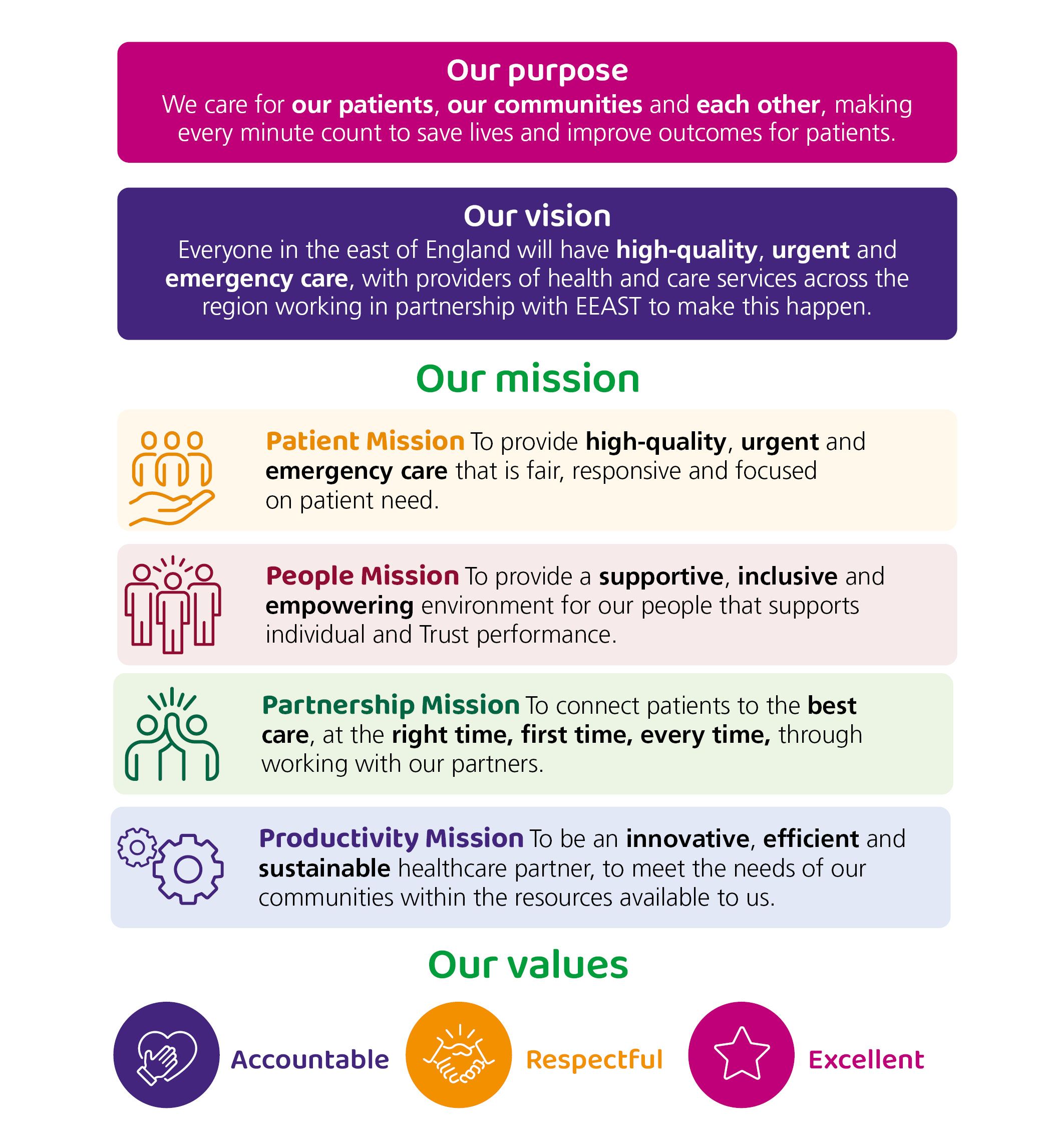
Underpinning the corporate strategy are three enabling strategies:
- Clinical Strategy
- People Strategy
- Sustainability Strategy.
It is envisaged that ambitions from the first Green Plan and this Addendum will be included and embedded in wider strategy.
6. Tracking and Reporting Progress
Over the next few months, as part of the consultation phase for our next Green Plan we will set out SMART (specific, measurable, achievable, relevant and time-bound) actions and associated KPIs for each of our key areas of focus.